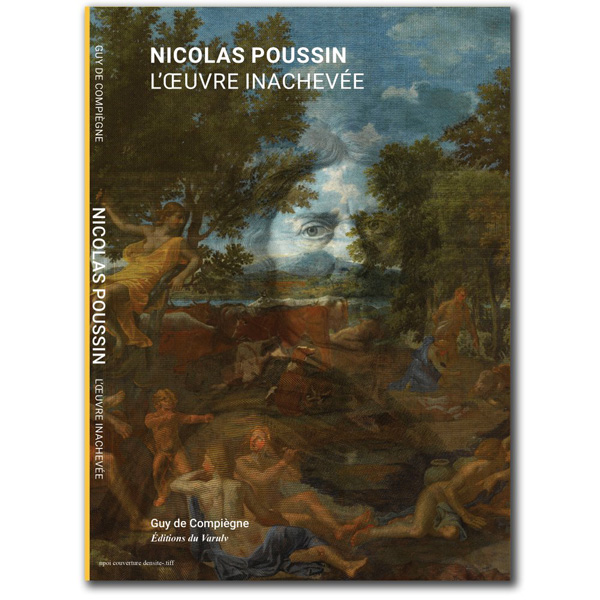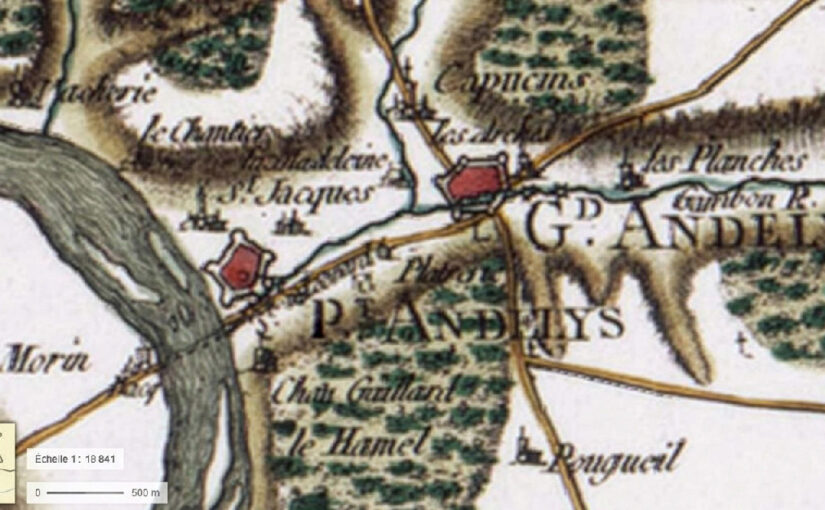
In May 2026, architect and Poussin enthusiast Guy de Compiègne gave a lecture, as part of the Amis du Louvre series, on the Norman roots of Nicolas Poussin. Far from the image of the Roman painter with which he is most often associated, this talk plunges back into the artist’s native Grand Andely: its sixteenth-century stained-glass windows, his very first contact with painting; the recurring floods etched into the collective memory of the town’s collegiate church; and the miraculous spring of Sainte-Clotilde, around which an entire sacred geography is woven. Guy de Compiègne reveals how this childhood territory runs through the artist’s work right up to his final painting, Apollo and Daphne – the work of a man who, in secret, never ceased to be an “Andelys painter.”
Here is the transcript of Guy de Compiègne’s lecture:
Poussin, the son of a soldier and a magistrate’s widow, was born in Villers, a small farming hamlet an hour’s walk from Grand Andely. His parents did not come from this peasant world, even though his mother owned a small farm and a few acres of land. Not particularly well-off, they presumably wanted their only son to be educated, even though the child had more taste for drawing than for Latin.
Until the Second World War, the only school in Grand Andely stood in the former episcopal manor adjoining the collegiate church. Through a door – now bricked up – Nicolas could move between the two buildings to admire a unique set of mid-sixteenth-century stained-glass paintings made by the Gisors glaziers Jean Buron and his sons. This family of glassmakers, together with their Beauvais-trained master Engrand Leprince, revolutionized the art of Norman stained glass by conceiving the window bay not as a juxtaposition of scenes bound by the mullions, but as a single grand composition.
The collegiate church’s stained-glass windows were young Nicolas’s first and only contact with painting before he met Quentin Varin in 1612, at the age of sixteen. Since this small town was not known for its painters, it is probably to these glaziers – and notably to the talented Romain Burron – that Poussin refers in his 1650 Self-Portrait. There, he sets aside his illustrious titles as academician or King’s painter to present himself to Chantelou not as a French or Roman painter, but as an “Andelys painter.”
The art of a glass-painter lies not only in drawing on glass but also in modeling flat areas of vivid color through grisaille work akin to wash drawing. Christ Healing the Blind, painted the same year as the Self-Portrait, already struck his contemporaries with the vividness of its coloring. The work echoes this treatment of drapery seen in stained glass, while the castle dominating the landscape recalls Château Gaillard on its chalky outcrop.
The name Andelys comes from Andelle, meaning “turbulent waters.” Built at the level of the Seine, in the bottleneck of the Gambon valley, the town was regularly threatened by winter floods – events etched into the memory of the collegiate church, of the townspeople, and of Poussin himself.
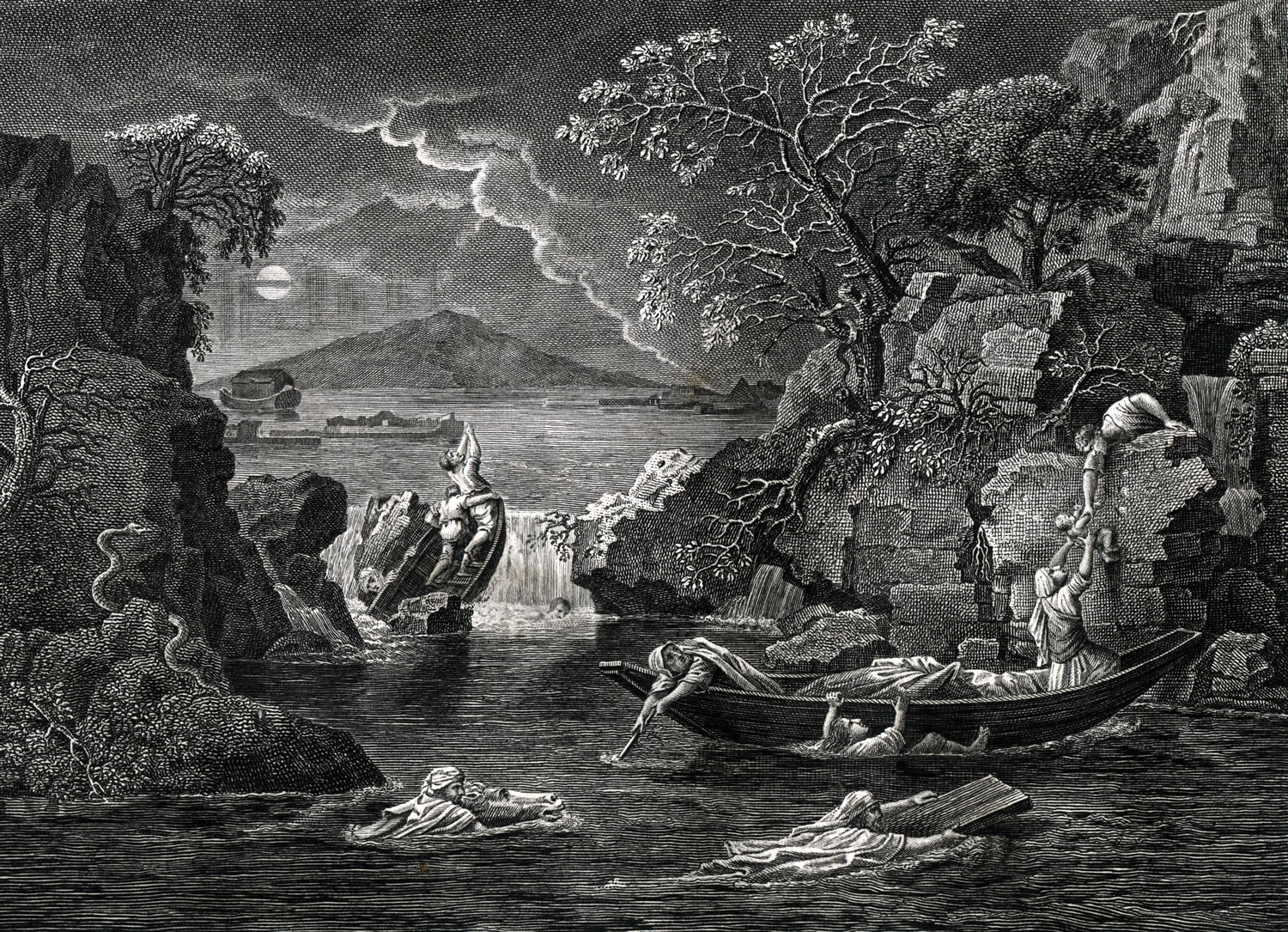
Two floods remain particularly memorable, and even though Poussin had already left Les Andelys for Rome, he can hardly not have heard of them. The archives record the flood of 22 December 1638: two years before his return to Paris, “the town of Grand-Andely was afflicted by great and extraordinary floods, which ruined the foundations of the church of Andely.” As for the flood of 21 December 1659, it is described as “the most dreadful deluge that can be imagined”; it preceded by only a few months the series of the Four Seasons, with its Deluge for Winter.
As we shall see, the 1638 flood was no less significant. Since these floods regularly undermined the church’s foundations, a monumental statue of Saint Christopher was placed at the base of one of the pillars of the nave. Its base, now moved near the entrance, depicts the rock of Château Gaillard beneath a flood. Thus, with every flood, the patron saint of pilgrims, carrying the Christ Child, seemed to walk on the water that filled the nave at Les Andelys.
The history of the collegiate church, built on a convent founded by Saint Clotilde, is just as intimately bound up with water – whether through its floods or through the miraculous spring that rises in the town. The spring’s water is said to have taken on the taste of wine for the Queen’s workers, and ever since, every 3 June, this miracle, the presence of relics, and the spring’s miraculous properties drew a huge crowd of pilgrims, who came to bathe in this water generously mixed with wine, hoping to witness a miracle.
The procession began at the collegiate church, or more precisely at the small Sainte-Clotilde chapel built to the north of the church over an early Christian immersion pool. Symbolically, the procession linked the site of the earliest baptisms, a primal spring, and a miracle evoking both Dionysus and the wedding at Cana. These layers of meaning overlap, and it seems worth recalling that young Nicolas’s birthday fell in June.
Let us leave this spring and return to the collegiate church, at the time when Varin painted his three canvases, including the Martyrdom of Saint Clair. The central tondo depicts the saint’s beheading, his head destined to be dipped in a fountain that would restore clear sight to the visually impaired. The arrangement of the figures makes the tondo appear concave, as if the artist had wanted to depict an eye, with the head as its iris. As for the small scenes supporting the tondo, they seem to be painted as if on spectacle lenses. Bellori – who could only have had this praise of Varin from Poussin himself – wrote that he was a master to whom connoisseurs promised a brighter renown than he then enjoyed, once his merit came to be fully recognized. One of his merits was certainly his original way of treating a subject.
At that time, work continued on the north façade, with the completion of the transept portal. The architect was probably Domenico Fiorentino, who worked for Charles de Bourbon, Archbishop of Rouen, whose residence was at Gaillon, on the other side of the Seine.
Unlike his French colleagues, Fiorentino had a perfect command of the classical orders and was a storyteller of genius. At the church of Saint-Nicolas in Troyes, he symbolically sprinkled the parishioners who came to witness the mystery of the Eucharist, by placing above the portal a large basin catching the blood from a monumental statue of Christ on the cross. At Les Andelys, facing the Sainte-Clotilde chapel, he placed two false gargoyles on the axis of each door. These take the form of two women who had come to draw the spring’s miraculous water and who now pour it out to “bless” the pilgrims sheltering in the church on the eve of the procession. The many watery details accompanying this evocation of the spring reveal that, for the confraternity in charge of the Sainte-Clotilde fountain, the architect turned his portal into a Roman nymphaeum. I mentioned earlier the terrible flood of December 1638, two years before Poussin’s return to Paris. It once again threatened the stability of the building, and the solution adopted was to add a series of square-plan pilasters. The massive form of these pilasters is unique, echoing the famous survey of the Baths of Diocletian that Chambray had Errard draw up in the spring of 1640. Now, Errard, Chambray, Chantelou and Poussin were together in Rome at that time, on the eve of returning to Paris. How can one not imagine that Poussin was consulted by his friends about work on his collegiate church?
Poussin, it is said, never returned to visit his native land and his few remaining relatives during his stay in Paris – yet anyone who has known exile might well think otherwise. Would this avid reader of Antiquity not also have wished, at the end of his life, to accomplish his own “Nostos”? Like a classical hero, he returns – in paint – to the most symbolic place of his youth. Does Les Andelys seem to be evoked one final time by this painter who supposedly turned away from his childhood, never to return to it?
This site of the Sainte-Clotilde fountain is quite literally at the source of his story, and it is the one he appears to have chosen as the setting for his final painting.
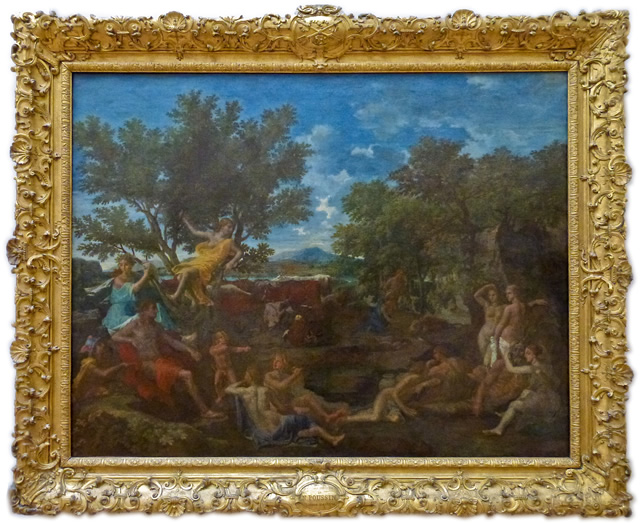
Nearing death, and much like Domenichino, who drew on the legend of Hercules and Cacus to depict the Velabrum and the Palatine at the very origins of Rome, Poussin chose Apollo and Daphne – an allegory of desire and earthly fertility – to bring his Roman family together, in a mythological age, around the spring of Grand Andely. The painting reads like a testamentary confession summarizing his family relationships: Poussin faces his wife; his nephew Gaspard Dughet steals his brushes while his niece Catherine looks on. Barbara cares for him in his old age, like the saint in her tower, perched in the tree that evokes the centuries-old lime tree by the fountain. Jean manages his affairs and here tends his flock – the Norman’s fortune – with his brother lying at his feet, having, it seems, achieved little in his life. In the foreground, Peneus points to the miraculous water spreading all around, while the Seine and the promontory of the future Château Gaillard can be made out in the distance.
This would remain mere speculation, had Poussin not taken care to give voice to Peneus, his father-in-law, in the guise of Marforio, one of Rome’s five “talking statues.” Marforio recites the words of the prologue to Ovid’s Metamorphoses: “My daughter,” he says to her, “at last you owe me a son-in-law, at last you owe me grandchildren – a satisfaction you can no longer deny me.” But Daphne, who hated marriage as though it were a crime, could not hear her father’s words without pain, and at first answered only with a modest blush that colored her lovely face; then, embracing him at once, she said: “Father, dearer to me than life itself, allow me to live as a maiden – a grace that Jupiter did not refuse to Diana.” This story resonates with that of Poussin who, throughout his life, painted fertility and desire, yet who, to his great sorrow, remained without a direct heir.
Examining what Poussin had before his eyes at Les Andelys has led us to consider the autobiographical dimension of his work. Even as Poussin sought to create timeless painting, he never forgot to remain present within the silent conversation between each of us and his art.
Nicolas Poussin, the Unfinished Work. Guy de Compiègne. Galignani, Librairie du Louvre. Book available on the Achetez de l’Art website